

In recent years, there have been several incidents, including sabotage to pipelines, damage to power and communication cables in Northern Europe. Research is now focusing on how underwater infrastructure can be inspected and secured more efficiently.
In August, researchers at NTNU achieved a breakthrough that could make the work both cheaper and more efficient.
“We have carried out a really exciting experiment! We used a small autonomous surface vessel (ASV) and a small light autonomous underwater vehicle (LAUV) to take images of pipelines from Melkøya towards the Snøhvit and Goliat oil and gas fields,” says Ingrid B. Utne, professor at NTNU’s Department of Marine Technology (IMT) and project leader of the project Safeguard.
Researchers have also tested a new, small autonomous underwater vehicle equipped with sonar, which can conduct reconnaissance and help build situational awareness.
Cooperation with Equinor
Two main test missions were carried out.
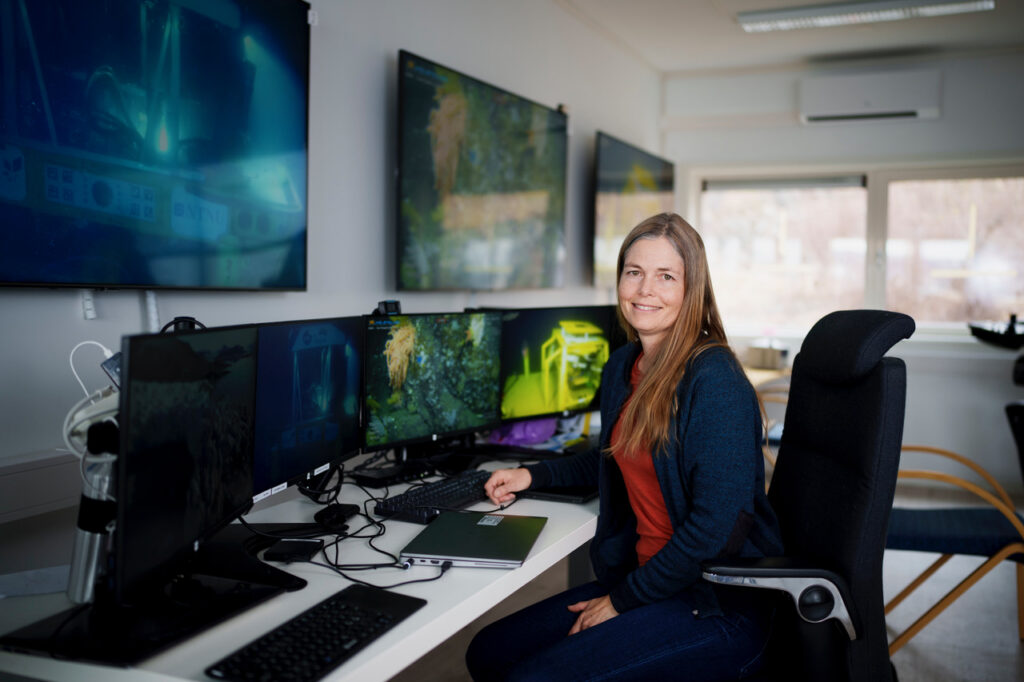
The testing was carried out from the control room at NTNU’s AUR-Lab – Applied Underwater Robotics Laboratory, in Trondheim in central Norway, while the vessels themselves are operating outside Hammerfest in the north of Norway, on Equinor infrastructure.
“We travelled out from Melkøya and back again. As far as we know long-distance missions using small and inexpensive autonomous vessels have not been carried out before” says Thale Eliassen Fink, a PhD candidate at the Department of Marine Technology, safely based in the control room in Trondheim.
On missions of this length, it is important that the underwater vehicle can handle unexpected events on its own, for example if it collides with the seabed, without us in Trondheim having to intervene and send it commands, she explains.
Read also: Autonomy research aims to make robots patrol the ocean
As part of the Safeguard project, her task is to enable a LAUV to carry out missions like these. She works closely with Enio Krizman, also a PhD candidate at IMT, who is working towards the same goal using an ASV.
He is also based in Trondheim, monitoring the inspection taking place 1,000 kilometres away.
The smaller underwater autonomous vehicle equipped with sonar has been tested by PhD candidate Jakob Odenwall, who has been in Hammerfest.
Both inspection and protection
“Our project is about new technology for protecting critical infrastructure that is important to both Norway and Europe,” says Krizman.

Both vessels and the floater are owned by AUR-Lab, which conducts research and development in applied underwater robotics.
“The LAUV depends on an ASV to receive positioning data. GPS cannot be used underwater,” says Utne.
The vessels can be used for routine inspections, but also in response to unusual activity – for example, ships that have switched off their position on AIS – automatic identification system for ships.
“Our goal is to develop tools that make it possible to improve situational awareness around pipelines in Norway at a low cost. This involves observation, surveillance, map activity and support sustained presence,” says Martin Ludvigsen, professor at IMT and head of AUR-Lab.
Protecting important infrastructure
Ludvigsen emphasises that these installations are important infrastructure.
“It is vital to have tools that can map and monitor pipelines and cables on the seabed without requiring extensive logistics, high costs, large vessels and many people.”
Snøhvit is located approximately 140 kilometres out in the Barents Sea, while Goliat is around 80 kilometres offshore.
“It has gone extremely well, even though we have faced some technical challenges along the way,” says Ingrid B. Utne. Preliminary tests were carried out in the Trondheimsfjord in May. Now, the same underwater vehicle and surface vessel have been operating autonomously outside Melkøya.
The Safeguard project is funded by the Research Council of Norway (Petromaks 2), Equinor and Vår Energi. The Norwegian Defence Research Establishment (FFI) is also a partner in the project.